Wilmington, DE, United States, Sept. 10, 2026 (GLOBE NEWSWIRE) -- API Supply Security Is Becoming the Defining Competitive Variable across Global Pharma Industry
The conversation around pharmaceutical supply chains has shifted in a way few procurement teams have fully absorbed. For two decades, the active pharmaceutical ingredients market was treated as a cost line to optimize. That logic is breaking down. Sourcing decisions now carry geopolitical weight, regulatory exposure, and competitive consequence, and the companies that recognized this early are negotiating from a structurally stronger position than those still chasing the lowest unit price.
Underneath the headline demand growth sits a quieter reorganization. Capacity is consolidating, regulatory scrutiny is tightening, and innovator molecules are pulling manufacturing toward more complex chemistries that few suppliers can execute at scale. What looks externally like a stable, mature sector is, in practice, a market where the active pharmaceutical ingredients market value chain is being redrawn around reliability, geographic resilience, and technical depth rather than price alone.
Request a Free Sample Report: https://marketmindsadvisory.com/request-sample/?report_id=45
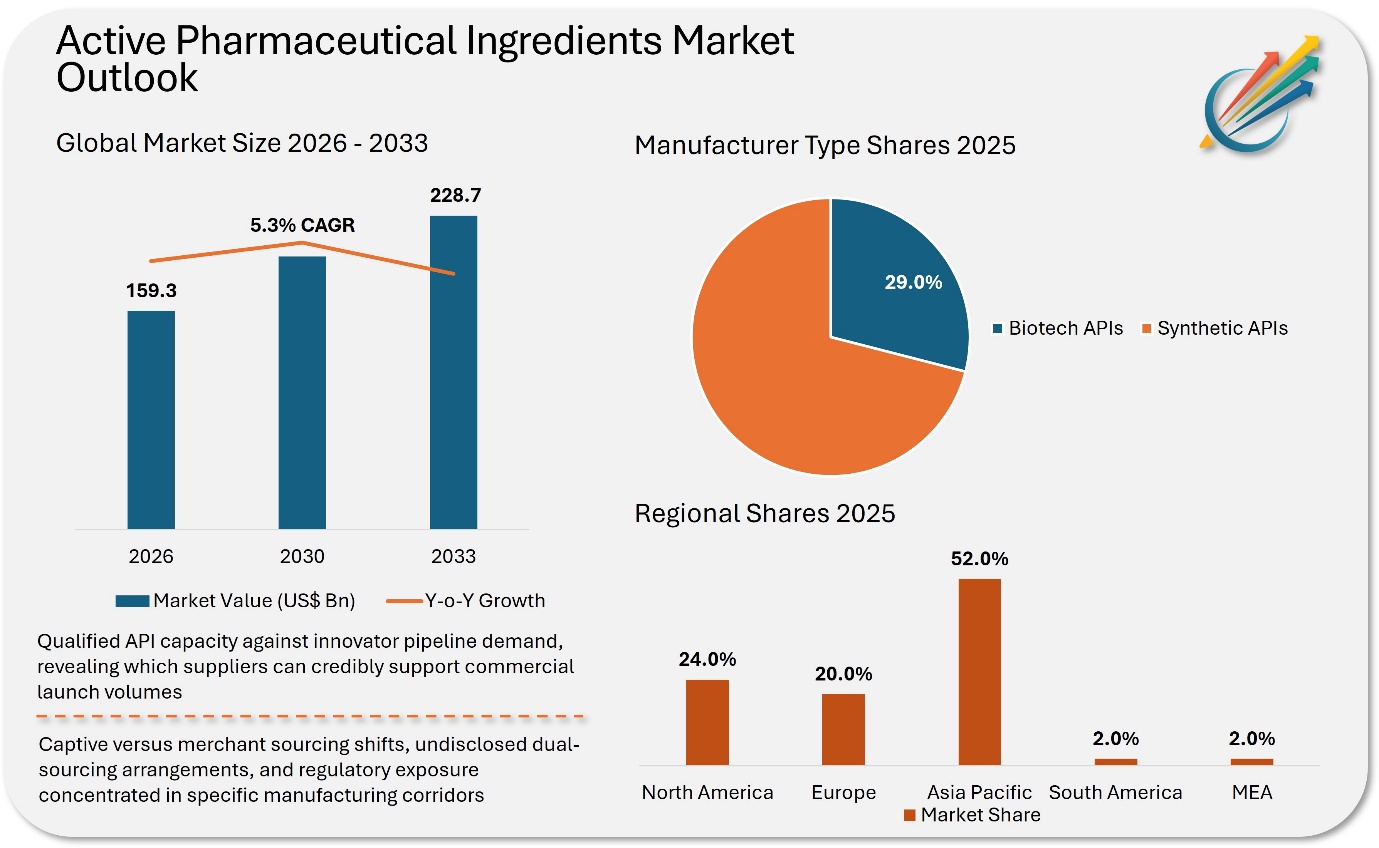
Key Takeaways from Active Pharmaceutical Ingredients Market
- The active pharmaceutical ingredients market is valued at US$ 159.3 billion in 2026, anchored by sustained therapeutic demand.
- Active pharmaceutical ingredients market is projected to reach US$ 228.7 billion by 2033 as complex chemistries expand share witnessing CAGR of 5.3% between 2026 and 2033.
- Biotech APIs are scaling faster than synthetic counterparts, driven by oncology and metabolic pipelines.
- Supply chain reshoring is redirecting capital investment toward North American and European facilities across active pharmaceutical ingredients market.
- Generic APIs still dominate volume, while innovative APIs capture a widening share of total value.
- Regulatory inspection intensity is becoming a primary differentiator between qualified and marginal suppliers in the active pharmaceutical ingredients market.
As per Senior Consultant from Market Minds Advisory, "Buyers have stopped asking only what an ingredient costs and started asking whether it will arrive, cleared and on time, for the next decade. Companies that lock qualified, geographically diversified supply over the next 18 to 24 months will set the cost and risk baseline competitors spend years trying to match."
The Current Sourcing Cycle Could Determine Long-Term Supply Resilience and Cost Stability
Supply security has moved from a contingency discussion to a board-level priority, and the timing is not arbitrary. Decisions made in the current cycle will shape competitive economics well into the next decade.
- Qualification timelines are the binding constraint: Validating a new API supplier and clearing regulatory filings can take 18 to 36 months. Buyers who start now will have secured options before the next disruption forces a reactive scramble at far worse terms.
- Capacity is being reserved ahead of demand: Innovator companies are increasingly locking manufacturing slots before final commercial volumes are confirmed. The merchant suppliers worth partnering with are filling their order books faster than spot buyers expect.
- Geographic concentration is now a quantifiable risk: A large share of global API supply still originates from a narrow set of regions. Treating diversification as a strategic asset rather than a procurement step is what separates resilient manufacturers from exposed ones.
The Active Pharmaceutical Ingredients Market is No Longer Defined by Unit Cost Alone
The most important change in the active pharmaceutical ingredients market is not demand growth. It is the redefinition of what makes a supplier valuable, and the gap between low-cost and high-capability players is widening.
- Complex chemistry is creating a capability premium: Peptides, highly potent compounds, and contrast media intermediates demand specialized infrastructure. Suppliers with this depth command pricing power that commodity producers cannot access, and innovators are willing to pay for execution certainty.
- Regulatory track record now functions as a moat: A clean inspection history has become a commercial asset. Buyers are consolidating spend toward suppliers with proven compliance, and recurring deficiencies effectively remove a manufacturer from serious consideration for higher-value programs.
- Backward integration is reshaping margin structures: Producers controlling key starting materials and intermediates are insulating themselves from raw material volatility. This vertical control is becoming a precondition for stable supply commitments rather than a competitive nicety.
Several Assumptions around Reshoring, Generic Growth, and Supplier Stability are Breaking Down
The reshoring story will deliver less manufacturing repatriation than headlines imply. Cost structures in established low-cost regions remain difficult to replicate, and most reshoring will concentrate on critical or strategically sensitive molecules rather than broad volume. The realistic outcome is selective dual sourcing, not wholesale relocation.
Generic API margins will compress further even as the active pharmaceutical ingredients market expands. Volume growth masks intensifying price pressure on commoditized molecules. The value migration toward complex and innovative APIs means aggregate growth and producer profitability are diverging, and many volume-focused suppliers will feel that squeeze.
The supplier base will consolidate faster than regulators or buyers currently anticipate. Rising compliance costs and capital intensity favor scaled players. Smaller manufacturers without specialization or financial depth will exit or be absorbed, narrowing buyer options precisely when supply security matters most.
Biotech Expansion, Regulatory Scrutiny, and Supply Diversification are Reshaping Competitive Dynamics
Therapeutic demand from chronic and age-linked disease
Aging populations and the rising prevalence of cardiovascular, oncology, and metabolic conditions are expanding the prescription base across developed and emerging economies. This demand is durable rather than cyclical, which gives API producers a stable planning horizon. The companies converting that visibility into disciplined capacity investment are positioned to capture growth without the margin erosion that reactive expansion typically produces.
The biologics and biotech API transition
Monoclonal antibodies, recombinant proteins, and therapeutic enzymes are claiming a growing share of new drug approvals. Biotech API manufacturing requires fundamentally different infrastructure, expertise, and capital than small-molecule synthesis. This shift rewards producers who invested ahead of the curve and creates a widening capability divide that latecomers will find expensive and slow to close.
Regulatory tightening across major markets
Inspection frequency and data integrity expectations have intensified across the FDA, EMA, and other authorities. Compliance is no longer a baseline requirement but a competitive sorting mechanism. Suppliers with mature quality systems are absorbing demand redirected away from manufacturers with regulatory histories that buyers now view as unacceptable execution risk.
Supply chain resilience as a procurement principle
Recent disruptions taught buyers that single-source dependency is a strategic liability. Dual sourcing, regional diversification, and inventory buffering are becoming standard practice all over active pharmaceutical ingredients market. This reorientation favors merchant API suppliers with multi-site footprints and gives geographically diversified producers a structural advantage in winning long-term contracts.
Ignoring Structural Risks Could Delay Competitive Positioning Across Global Pharmaceutical Manufacturing Networks
- Pricing pressure on generic APIs: Intense competition on commoditized molecules continues to compress margins, threatening the viability of producers without scale or specialization.
- Raw material and intermediate volatility: Dependence on a narrow set of upstream suppliers exposes manufacturers to cost spikes and availability gaps that can disrupt delivery commitments.
- Regulatory enforcement risk: A single significant inspection finding can remove a supplier from qualified status, with revenue consequences that take years to recover.
- Geopolitical and trade exposure: Tariffs, export controls, and shifting trade policy can disrupt established sourcing corridors with limited warning.
- Capital intensity of complex chemistry: Building biotech and high-potency capability demands large, long-horizon investment that smaller players struggle to finance.
- Environmental and compliance costs: Stricter effluent and emissions standards raise operating costs, particularly for older synthetic API facilities.
These risks are real and warrant active management, but they shape the pace and distribution of growth rather than reverse it. The directional conclusion holds. Demand fundamentals and capability differentiation continue to favor producers who plan deliberately.
Market Dynamics Shaping the Active Pharmaceutical Ingredients Market
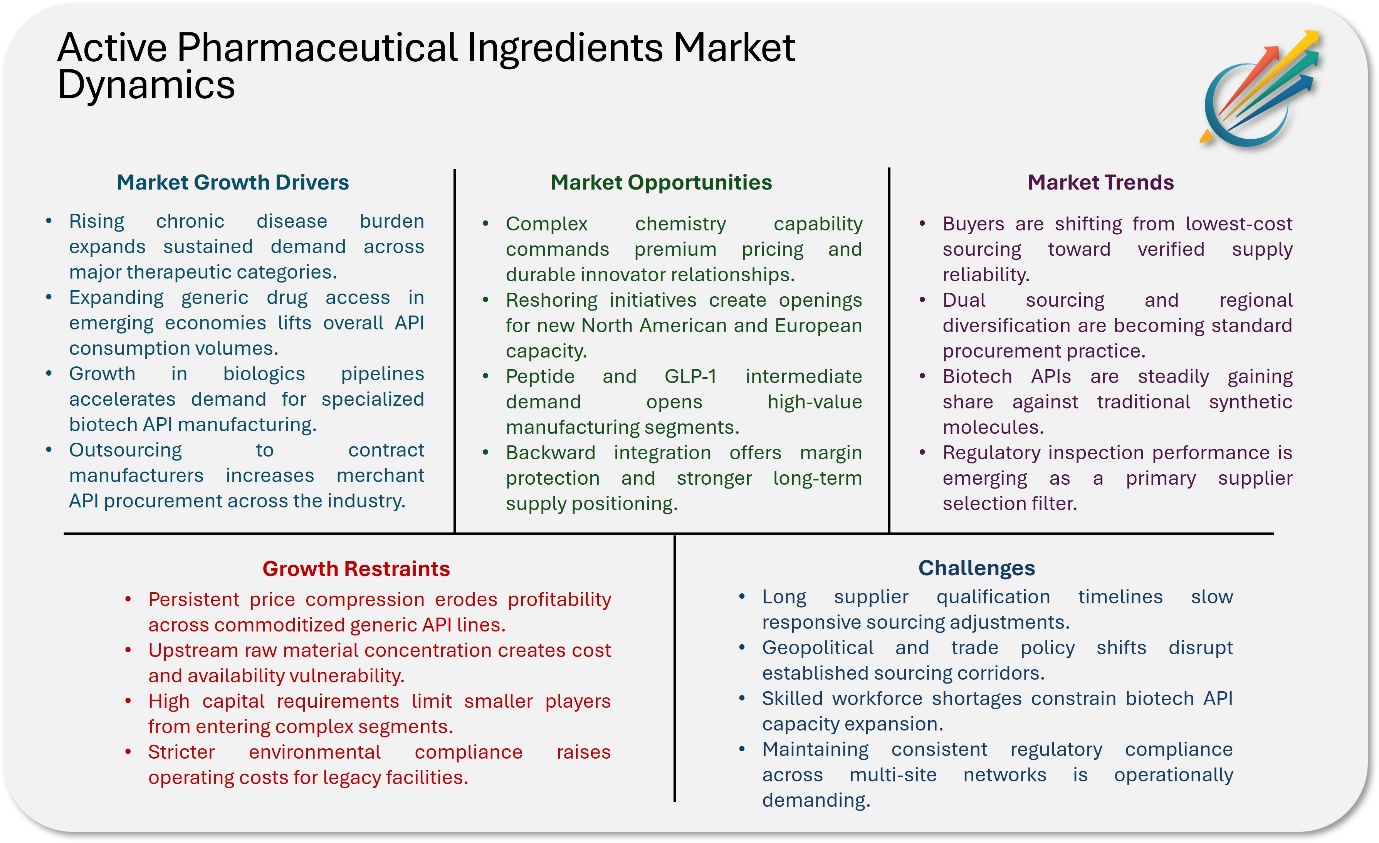
Active Pharmaceutical Ingredients Market Segmentation
By Type
- Generic APIs
- Innovative APIs
Generic APIs continue to account for the majority of volume, supported by patent expiries and expanding access in price-sensitive markets. Innovative APIs, though smaller in unit terms, are capturing a disproportionate share of value as novel therapeutics enter the active pharmaceutical ingredients market. The economic divergence between the two is widening, with volume growth concentrated in generics and margin growth concentrated in innovative molecules. Producers are increasingly choosing which side of that divide to compete on.
By Manufacturer Type
- Captive APIs
- Merchant APIs
Captive production, where pharmaceutical companies manufacture in-house, remains significant for strategically sensitive or proprietary molecules. Merchant APIs, supplied by dedicated external producers, are gaining ground as outsourcing intensifies and buyers seek flexible, diversified sourcing. The merchant segment benefits most directly from supply security concerns, since multi-site merchant suppliers offer the geographic resilience that single captive facilities cannot. This structural tailwind favors scaled, well-qualified merchant producers across active pharmaceutical ingredients market.
By Synthesis Type
- Biotech APIs
- Monoclonal Antibodies
- Hormones
- Cytokines
- Recombinant Proteins
- Therapeutic Enzymes
- Vaccines
- Others
- Synthetic APIs
Synthetic APIs still represent the largest portion of the market by volume, underpinning the bulk of small-molecule drug production in the active pharmaceutical ingredients market. Biotech APIs, however, are the faster-growing segment, propelled by oncology, immunology, and metabolic disease pipelines. The capability gap between the two is consequential. Biotech manufacturing demands specialized infrastructure and expertise, creating a higher barrier to entry and a more defensible competitive position for established producers.
By Application
- Cardiovascular Diseases
- Oncology
- CNS and Neurology
- Orthopedic
- Endocrinology
- Pulmonology
- Gastroenterology
- Nephrology
- Ophthalmology
- Others
Cardiovascular and oncology applications anchor demand, reflecting global disease prevalence and active innovator pipelines. Oncology in particular is pulling demand toward complex, high-potency APIs that command premium economics. Endocrinology is gaining momentum on the back of metabolic disease therapies, including the GLP-1 class. The breadth of therapeutic application gives the active pharmaceutical ingredients market diversified, resilient demand that is insulated from any single category slowdown.
By End User
- Pharmaceutical & Biotechnology Industry
- Contract Manufacturing Organizations
- Contract Research Organizations
- Others
The pharmaceutical and biotechnology industry remains the dominant end user, sourcing APIs for both proprietary and generic portfolios. Contract manufacturing organizations are the fastest-expanding channel as outsourcing accelerates across the value chain. Contract research organizations contribute steady demand tied to clinical development activity. The growing role of contract organizations reflects a structural preference for variable, specialized capacity over fixed in-house investment across active pharmaceutical ingredients market.
Shape this report around your priorities: https://marketmindsadvisory.com/request-customization/?report_id=45
Regional Market Outlook
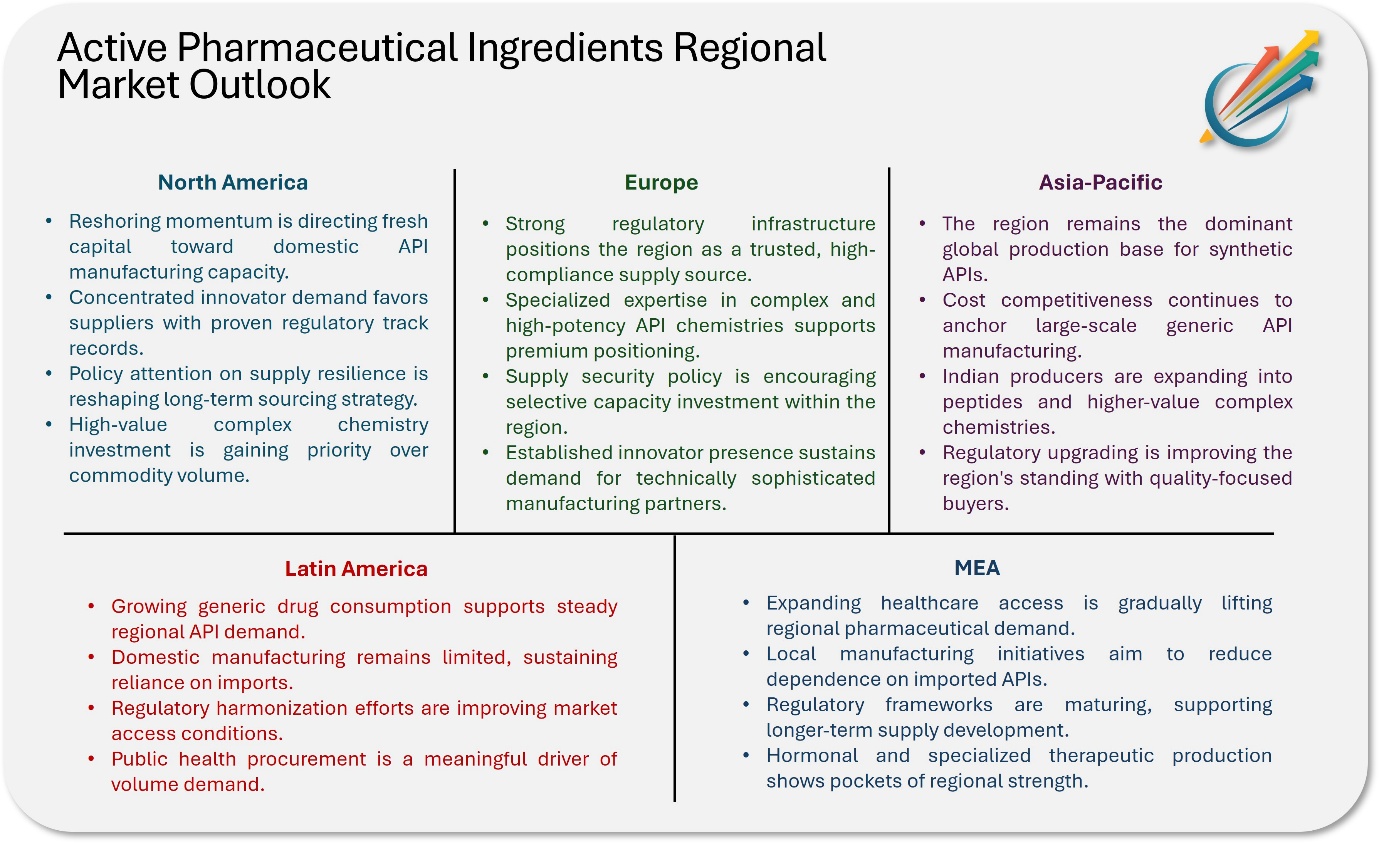
Investment Focus where the Lucrative Opportunity is Anticipated
Complex and high-potency chemistry capacity
The clearest value concentration sits in suppliers capable of manufacturing peptides, highly potent APIs, and contrast media intermediates. These chemistries face limited qualified capacity and rising innovator demand. Capital directed here buys pricing power and contract durability that commodity production cannot replicate, making it the most defensible position in the active pharmaceutical ingredients market.
Biotech API manufacturing infrastructure
Investment in monoclonal antibody, recombinant protein, and therapeutic enzyme capacity aligns with where new drug approvals are heading. The infrastructure barrier is high, which protects early movers. Producers building this capability now are positioning ahead of a demand curve that synthetic-only manufacturers cannot serve, securing compounding advantages over time.
Geographically diversified merchant capacity
Merchant suppliers with qualified multi-region footprints are capturing the procurement shift toward resilience. Buyers will pay for assured supply. Capital that funds diversified, well-regulated capacity meets a structural demand for sourcing security, and that demand is strengthening rather than fading across the active pharmaceutical ingredients market.
Backward integration into starting materials
Controlling key intermediates and starting materials insulates producers from upstream volatility and strengthens their ability to make firm supply commitments. This vertical depth is becoming a precondition for winning long-term innovator contracts. Investment here protects margin and converts supply reliability into a contractable competitive asset.
What This Means for Decision-Makers
Pharmaceutical and Biotechnology Companies - Treat API sourcing as a strategic capability, not a procurement task. Begin qualifying diversified, complex-chemistry suppliers now, because the buyers who secure capacity early will define cost and reliability terms competitors cannot easily match.
Contract Manufacturers - The opportunity is concentrating in complex chemistry and biotech APIs. Investment in specialized capability and a clean regulatory record converts directly into pricing power and contract durability as buyers consolidate spend toward proven partners.
Investors - The investment thesis has matured. Geographically diversified merchant capacity, high-potency chemistry, and backward integration offer clearer risk-return profiles than commodity generic exposure within the active pharmaceutical ingredients market.
Policymakers - Supply security depends on practical incentives, not mandates alone. Targeted support for critical-molecule capacity and faster regulatory pathways will do more to reduce dependency than broad reshoring rhetoric that underestimates cost realities.
Competitive Landscape: Active Pharmaceutical Ingredients Market
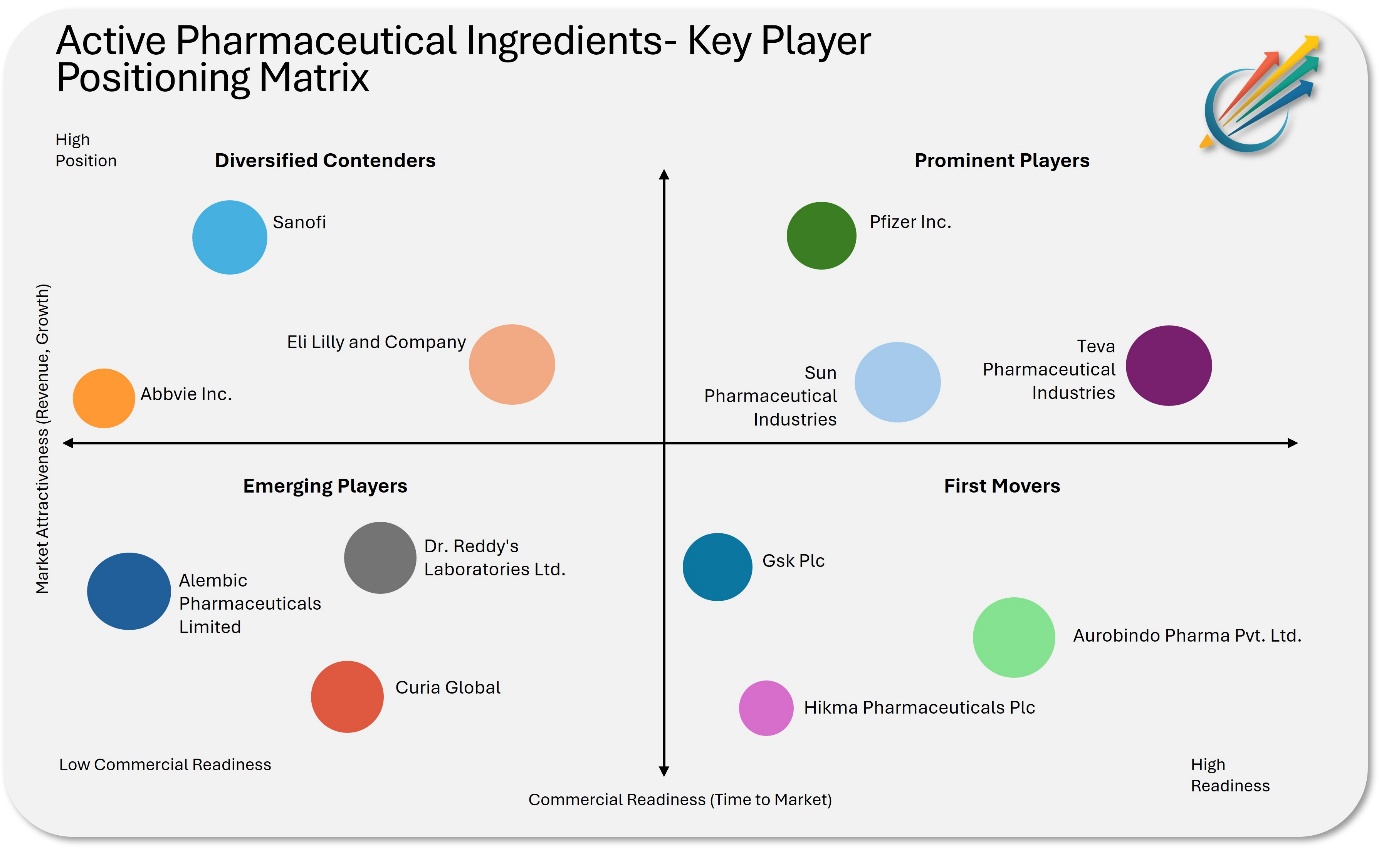
Recent Market Developments
- In March 2026, Cambrex Corporation completed initial engineering studies for a new large-scale API manufacturing plant in Charles City, Iowa, advancing a planned U.S. capacity expansion.
- In March 2026, Cambrex Corporation confirmed a continued expansion at its Milan, Italy site, adding analytical development and process research capabilities.
- In February 2026, Curia Global, Inc. was recognized among leading suppliers for epinephrine API synthesis and scale-up serving the North American market.
- In January 2026, Divi's Laboratories Limited continued ramping its Kakinada complex, expanding capacity for complex APIs, contrast media intermediates, and custom synthesis.
Market is segmented by Type (Generic APIs, Innovative APIs), Manufacturer Type (Captive APIs, Merchant APIs), Synthesis Type (Biotech APIs, Synthetic APIs), and Application (Cardiovascular, Oncology, CNS and Neurology, Oncology and beyond)
Get Access to complete Analysis, Buy Now: https://marketmindsadvisory.com/buy-now/?report_id=45
Trending Reports
- Biologics and Biosimilars Market
- Respiratory Biologics Market
- Psoriasis Biosimilars Market
- Placental Growth Factors Market
- Peptide Drug Conjugates Market
- Oncolytic Adenovirus Market
- Next Generation Immunotherapies Market
- Long-Acting Monoclonal Antibodies Market
- Stem Cell Therapy Market
- Weight Loss and Obesity Management Market
Why choose Market Minds Advisory
Market Minds Advisory delivers decision-grade intelligence to executives across machinery, packaging, chemicals, automotive, ICT, food and beverage, consumer goods, and healthcare. We help organizations sharpen market expansion strategies, accelerate share gains, refine brand positioning, and enable account-level growth. Our forecasting integrates primary interviews, proprietary demand models, and continuous market validation, producing the kind of clarity volatile and emerging industries require. Backed by over a decade of sector expertise, our research surfaces white space, opportunity gaps, and competitive blind spots, accounting for recent developments and geopolitical risk. We help businesses see the future of their markets.
Contact Us
Market Minds Advisory
1521 Concord Pike, Suite 301
Wilmington, DE 19803
United States
Email: sales@marketmindsadvisory.com
Website: https://marketmindsadvisory.com/