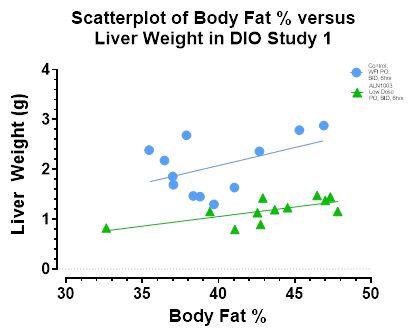
- This statistical finding supports a lower liver-weight signal after adjustment for body fat percentage, suggesting the finding was not fully explained by measured body fat in this model
- Liver-weight findings are directionally consistent with previously disclosed data on lower liver injury enzymes, lower NAFLD Activity Scores (NAS), lower HOMA-IR, an insulin-resistance-related biomarker, and favorable adipose endocrine signaling
FORT LAUDERDALE, Fla., June 29, 2026 (GLOBE NEWSWIRE) -- Alaunos Therapeutics, Inc. (Nasdaq: TCRT), an early-stage biotechnology company developing novel therapeutics, today announced a new preclinical statistical analysis of liver weight adjusted for body fat percentage from its previously reported non-Good Laboratory Practice (non-GLP) diet-induced obesity (DIO; high fat diet) mouse Study 1 of ALN1003, the Company’s investigational oral, non-hormonal, non-incretin small-molecule metabolic candidate.
As depicted in the figure below, in the 48-day DIO Study 1, ALN1003-treated animals had lower liver weight than controls after adjustment for body fat percentage in a standard ANCOVA analysis (p=0.000005), with the same conclusion confirmed using heteroscedasticity-robust HC3 standard errors as a sensitivity analysis (p=0.000015). This statistical finding indicates that the lower liver weight associated with ALN1003 treatment was not fully explained by measured body fat percentage in this model. While this analysis does not establish the specific mechanism, it provides supportive evidence for further controlled preclinical evaluation of ALN1003’s liver-related effects.
Supportive Liver-Related Analyses
This body-fat-adjusted liver-weight finding is directionally consistent with previously disclosed findings from DIO Study 1, including selected liver histology, liver marker, HOMA-IR, and adipose endocrine biomarker results:
- Liver histology and liver markers: The body-fat-adjusted liver-weight finding is directionally consistent with a previously reported blinded pilot pathology review of selected liver samples. In that review, ALN1003-treated animals showed qualitative findings consistent with lower hepatic steatosis and lower mean NAS scores in samples selected (2.7 compared with 5.0 for selected controls), alongside a 43% reduction in absolute liver weight and significantly lower liver-injury markers (ALT, AST, and ALP). These limited pilot pathology findings do not establish MASLD resolution, fibrosis reversal, inflammation improvement, or clinical efficacy.
- Insulin-resistance-related biomarkers: Alaunos previously disclosed that ALN1003-treated animals had lower fasting insulin and lower HOMA-IR, a calculated fasting glucose/insulin index commonly used as an insulin-resistance-related biomarker. The HOMA-IR finding remained statistically significant after adjustment for percentage body fat (ANCOVA p=0.0006; HC3 robust sensitivity p=0.0014). This body-fat-adjusted liver-weight finding aligns with the broader findings of lower fasting insulin and lower HOMA-IR previously disclosed.
- Adipose endocrine biomarkers: Alaunos previously disclosed numerically lower leptin, significantly higher adiponectin, and a significantly higher adiponectin-to-leptin ratio in DIO Study 1. The finding that liver weights are lower even when controlling for body fat percentage is directionally consistent with these favorable adipose endocrine biomarker changes. These findings support further evaluation of ALN1003’s effects on adipose endocrine signaling and liver-related measures.
“This analysis adds an important supportive piece to the ALN1003 preclinical dataset,” said Holger Weis, CEO of Alaunos. “In the 48-day DIO mouse study, ALN1003-treated animals showed lower liver weight after adjustment for body fat percentage, which is directionally consistent with our previously reported liver marker, selected histology, HOMA-IR, and adipose endocrine biomarker findings. These findings support continued development of ALN1003 and further controlled studies to evaluate formulation, exposure-response, tolerability, and MASH-relevant liver biology.”
About ALN1003
ALN1003 is an investigational oral metabolic therapeutic being evaluated for potential relevance to multiple components of metabolic dysfunction, including insulin resistance, adipose tissue signaling, and hepatic lipid metabolism. Preclinical studies to date suggest potential relevance across metabolic syndrome and related conditions, including obesity, metabolic dysfunction-associated steatotic liver disease (MASLD), and insulin resistance.
Alaunos has published a non-confidential investor presentation, Obesity and Metabolic Disorders Program — Results of Studies of ALN1003 in Diet-Induced Obese Mouse Model (May 2026), containing the previously disclosed integrated data summaries, statistical analyses, representative liver histology images, and study conclusions referenced above. The presentation is available on the Investors section of the Company's website at www.alaunos.com.
About Alaunos Therapeutics
Alaunos Therapeutics is a biotechnology company focused on developing novel therapeutics. The Company’s obesity and metabolic disorders program is advancing ALN1003, an oral small-molecule candidate being evaluated as a potential differentiated, non-hormonal, non-incretin approach for obesity- and metabolic-disease-relevant biology.
Cash Position and Important Limitations
As previously disclosed, as of March 31, 2026, the Company had cash and cash equivalents of approximately $0.354 million. The Company intends to pursue additional financing to support continued operations and advancement of its preclinical obesity and metabolic disorders program.
These findings are based on non-GLP preclinical studies and should be interpreted with appropriate caution. Limitations include limited sample sizes; histological analysis limited to a sample of available livers; single-timepoint biomarker assessments; known constraints of HOMA-IR interpretation in rodent models; qualitative/semi-quantitative pathology scoring; the post hoc nature of the body-fat-adjusted liver-weight analysis and nominal p-values; liver weight as an indirect liver-related measure rather than a direct quantification of hepatic lipid content. ALN1003 has not been evaluated in human clinical trials, and its safety and efficacy in humans have not been established. Findings from mouse studies may not translate to human disease.
Cautionary Note Regarding Forward-Looking Statements
This press release contains forward-looking statements. Forward-looking statements are statements that are not historical facts, and in some cases can be identified by terms such as "may," "will," "could," "expects," "plans," "anticipates," "believes" or other words or terms of similar meaning. These statements include, but are not limited to, statements regarding Alaunos Therapeutics, Inc.'s ("Alaunos" or "the Company") business and strategic plans, the timing of the Company's research and development programs, including potential data read-out dates as well as any potential patent filings for the Company's obesity and metabolic disorders program, statements regarding the interpretation of liver-weight/body-fat-adjusted analyses, liver-related effects, HOMA-IR, adipose endocrine biomarkers, future controlled studies, MASH-relevant liver biology, financing, and the availability or content of investor materials.
These forward-looking statements are based on current expectations and assumptions that are subject to risks and uncertainties, which could cause actual results to differ materially. Important factors that could cause actual results to differ materially include, but are not limited to: changes in the Company's operating plans that may impact its cash expenditures; uncertainties built into research and development such as preclinical mouse data not translating to human trials, or challenges in scaling up formulations, including the risk that early non-GLP study results may not be replicated in confirmatory studies or pose safety concerns in IND-enabling studies; delays or failures in future studies; whether Alaunos' product candidates will advance further in the clinical trial process, including getting approval by the U.S. Food and Drug Administration (FDA) or other foreign health authority to conduct clinical trials and whether and when, if at all, they will receive final approval from the FDA or equivalent foreign regulatory agencies and for which uses; challenges to the strength and enforceability of Alaunos' intellectual property rights (such as patent disputes); competition from other pharmaceutical and biotechnology companies (including in the crowded obesity treatment market); funding shortages or market changes affecting our cash needs; tolerability issues from drug administration; the inherent uncertainties in drug development, including potential failures optimizing formulations, mechanistic studies, or large-animal pharmacokinetics that could delay IND-enabling activities; manufacturing and supply chain disruptions related to CMC work; and other factors discussed in our latest Form 10-Q and Form 10-K filed with the Securities and Exchange Commission (SEC). Forward-looking statements may also be protected if they are immaterial.
We caution you not to place undue reliance on these forward-looking statements, which speak only as of the date of this press release. Except as required by law, Alaunos undertakes no obligation to update these statements to reflect events that occur or circumstances that exist after the date hereof.
Investor / Media Contact
ir@alaunos.com
A photo accompanying this announcement is available at https://www.globenewswire.com/NewsRoom/AttachmentNg/65e51451-5817-42eb-8946-c1a4e458d96a