CMA CGM, Copersucar and Bunker One Complete First Bioethanol Bunkering of a Deep-Sea Containership in Brazil, at the Port of Santos
PR Newswire
SÃO PAULO, July 13, 2026
Initiative positions Brazil at the forefront of maritime decarbonization, demonstrating bioethanol as a competitive solution for sustainable shipping
Highlights
- CMA CGM IRON was supplied with bioethanol at the Port of Santos in the first bunkering operation of its kind for a deep-sea containership in Brazil.
- The operation highlights the potential of bioethanol as a renewable marine fuel and reinforces Brazil's role in supporting the maritime industry's energy transition.
- The project was made possible through the collaboration of CMA CGM, Copersucar, the Terminal of Santos Brasil, AGEO Terminais, Bunker One and Everllence.
SÃO PAULO, July 13, 2026 /PRNewswire/ -- CMA CGM Group, a global player in sea, land, air and logistics solutions; Copersucar, the world's leading sugar and bioethanol trading company; AGEO Terminais, the largest liquid bulk storage operator at the Port of Santos; Santos Brasil, the biggest container teminal in Brazil; and Bunker One, a subsidiary of the Danish Bunker Holding Group, a global leader in bunker fuel trading; successfully completed a bioethanol bunkering operation for the CMA CGM IRON, the first 13,000 TEU tri-fuel certified engine containership, at the Port of Santos on July 12, 2026.
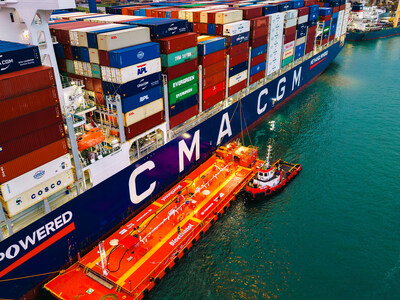
This pioneering operation represents a major milestone for the decarbonization of maritime transport, positions Brazil among the countries capable of carrying out this type of bunkering operation, and reinforces bioethanol as a readily available solution to reduce greenhouse gas emissions from the shipping sector.
The bioethanol supplied by Copersucar benefits from a well-established and certified supply chain. Sugarcane expansion takes place mainly on degraded pastureland, while Brazil's RenovaBio program establishes stringent sustainability and zero-deforestation requirements.
The bunkering required logistical and operational coordination among multiple stakeholders across the value chain, involving the transport of bioethanol to the Port of Santos, its storage in dedicated infrastructure, and its transfer to the vessel via a specialized barge, using the highest international standards of safety and efficiency.
The initiative also benefited from the collaboration of several regulatory, operational and port authorities, whose support was essential in enabling this milestone for sustainable shipping while further strengthening the Port of Santos as a benchmark for innovation in the energy transition.
The operation provides practical evidence that bioethanol offers the attributes needed to accelerate the decarbonization of maritime transport. In addition to delivering significant reductions in greenhouse gas emissions, it offers immediate commercial-scale availability, an already established production infrastructure in Brazil, and economic competitiveness — key advantages amid growing global demand for sustainable marine fuels.
Positioning Brazil and the Port of Santos as a Future Low-Carbon Marine Fuel Hub
Beyond this first demonstration, the Port of Santos and Santos Brasil container terminal are positioning themselves and Brazil as a future low-carbon marine fuels hub for South America. As the continent's largest port and a major gateway for global trade, Santos has the potential to connect Brazil's renewable energy resources with international shipping demand. CMA CGM's acquisition of Santos Brasil in 2025 reinforces the Group's long-term commitment to the port and reflects its ambition to support the development of the infrastructure and partnerships needed to accelerate the maritime energy transition.
Advancing Alternative Fuels to Decarbonize Maritime Transport
As part of its commitment to achieve Net Zero Carbon by 2050, CMA CGM continues to deploy and evaluate the most effective solutions available to reduce greenhouse gas emissions across maritime transport and logistics. By 2031, the Group expects to operate around 200 containerships capable of using low-carbon energies.
The CMA CGM IRON, delivered in 2025, is the Group's first vessel in a series of twelve 13,000 TEU containerships, equipped with the world's first tri-fuel engine certified to operate on bioethanol: Everllence-B&W G95ME-C10.5-LGIM.
"Together with our partners, we have shown that innovation can move from the laboratory to real maritime operations. The certification of our first tri-fuel vessel is a major technological milestone for CMA CGM. It opens the way for the broader use of lower-carbon fuels and gives us new options to accelerate the decarbonization of our shipping activities" said Christine Cabau Woehrel, Executive Vice President Assets & Operations, CMA CGM.
Copersucar delivers renewable energy solutions at scale that drive the energy transition while contributing to global food security. Organized as a unique and integrated ecosystem of specialized businesses, the company is the world's leading sugar and bioethanol trading company. It also operates in renewable electricity and biomethane, supported by an efficient multimodal logistics platform.
"This operation demonstrates Copersucar's ability to connect production, logistics and markets to enable bioenergy solutions at scale. More than a pioneering bunkering operation, we are creating the conditions for bioethanol to become a competitive component of the maritime energy mix, further strengthening Brazil's leadership in the transition to a low-carbon economy," said Tomás Manzano, CEO of Copersucar.
Bunker One is a subsidiary of the Danish Bunker Holding Group, a global leader in the supply and trading of marine fuels. The company's strong environmental, social and governance (ESG) practices have earned it the Sustainability Seal awarded by Brazil's Ministry of Ports and Airports (MPor).
"This operation can be considered a milestone in the global maritime industry's energy transition, as the sector begins to adapt to this new model. Today, Around 70 vessels of the global fleet are capable of operating on methanol and, consequently, with bioethanol. Over the next few years, however, an additional 400 vessels are expected to be delivered from shipyards ready to sail using a non-fossil fuel", said Flavio Ribeiro, CEO of Bunker One.
Photo - https://mma.prnewswire.com/media/3005806/Foto_Copersucar.jpg
 View original content to download multimedia:https://www.prnewswire.com/news-releases/cma-cgm-copersucar-and-bunker-one-complete-first-bioethanol-bunkering-of-a-deep-sea-containership-in-brazil-at-the-port-of-santos-302824320.html
SOURCE COPERSUCAR S.A