Lewes, Delaware, Aug. 28, 2026 (GLOBE NEWSWIRE) -- According to a newly published industry analysis by Verified Market Research®, the Gravity Mixer Market Size was valued at USD 1.29 Billion in 2025 and is projected to reach USD 2.30 Billion by 2033, registering a Compound Annual Growth Rate (CAGR) of 7.3% across the 2025 - 2033 forecast period. The report, spanning more than 240 pages, provides a detailed evaluation of the Global Gravity Mixer Market across five regions, four equipment types, and two primary application categories, alongside a competitive assessment of the leading vendors shaping the Gravity Mixer Industry. The findings indicate that Gravity Mixer Market Growth will be underpinned by rising industrial output, expanding chemical processing capacity, and a sustained need for efficient, repeatable bulk solids mixing across manufacturing environments worldwide.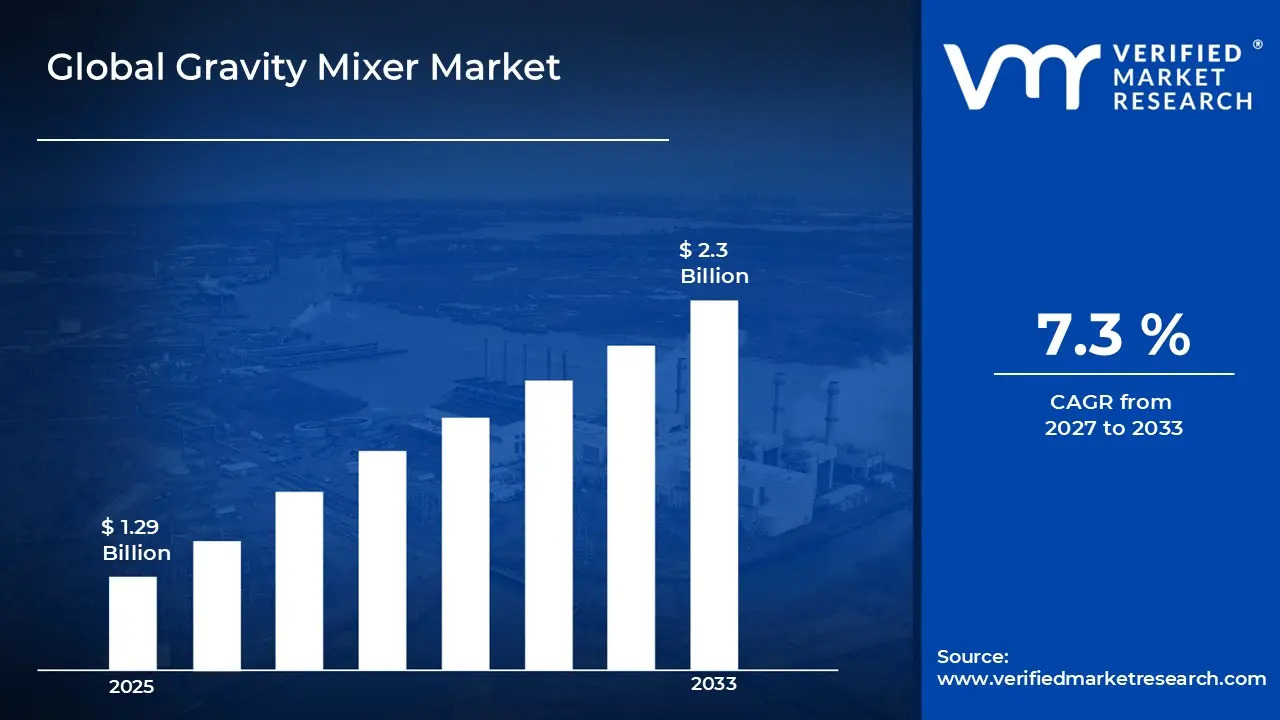
Download a free sample to access exclusive Insights, Data Charts, And Forecasts From Gravity Mixer Market Sample Report
Verified Market Research® notes that growth from the USD 1.29 Billion base value toward the USD 2.30 Billion 2033 projection reflects steady, structural adoption rather than a short-cycle procurement spike. This trajectory is consistent with how gravity-based mixing systems are specified in production environments that prioritize consistency, reduced downtime, and scalable batch operations. Supply-side improvements including tighter control of mixing parameters and ongoing design refinements are also expected to reduce variability in output quality, reinforcing sustained expansion of the Gravity Mixer Market through the end of the forecast period.
Gravity Mixer Market Overview: Scope, Definition, and Market Boundaries
The Gravity Mixer Market encompasses industrial equipment engineered to blend, homogenize, or dry-mix bulk solids primarily through gravitational flow and controlled material movement. Market participation is defined by the sale, deployment, and technical support of gravity-mixing systems built around gravity-driven filling, mixing zones, and discharge behavior, rather than systems that rely on turbulent mechanical agitation alone. The Gravity Mixer Market includes gravity mixers supplied as standalone machines as well as integrated solutions where gravity-based mixing constitutes the core process step within a production line, together with the engineering services typically required for correct installation, commissioning, and adaptation to material properties such as particle size distribution, bulk density, moisture sensitivity, and flowability.
Within the analytical boundary of the Gravity Mixer Market, the relevant product definition is the mixing system that performs blending or homogenization using gravity as the dominant driving mechanism for material movement through the mixing chamber or mixing interface. This boundary also extends to configurations where a gravity mixer is paired with complementary handling elements when those elements are integral to achieving the defined mixing duty cycle and performance outcomes, such as controlled feeding and discharge arrangements designed to preserve homogeneity. Where gravity is present but the primary mixing effect is delivered by a different mechanism that supersedes gravity-driven mixing, those solutions fall outside the defined market scope.
To remove ambiguity, the Gravity Mixer Market explicitly excludes several adjacent categories that are commonly confused with gravity mixing. Pneumatic conveying-only systems are excluded because their value chain role is transport rather than mixing and homogeneity generation. High-shear or purely mechanically agitated mixers are excluded where the mixing mechanism is primarily shear-driven or impeller-driven, since their process differentiation and design intent diverge from gravity mixing. Bulk solid storage and bin-only solutions are also excluded when they do not implement a gravity mixing operation intended to achieve uniformity. These exclusions ensure that comparisons across regions, types, and applications remain analytically coherent within the Gravity Mixer Market.
The Gravity Mixer Market matters to industrial and chemical stakeholders because mixing performance directly influences product uniformity, yield, and downstream processing efficiency. Manufacturers are under ongoing pressure to improve batch-to-batch consistency, and gravity mixer configurations align closely with use cases where controlled residence time and predictable discharge behavior support quality assurance targets. In chemical applications, mixing performance influences downstream reaction efficiency and impurity profiles, making equipment selection a meaningful driver of overall Gravity Mixer Market Growth.
Download a free sample to access exclusive Insights, Data Charts, And Forecasts From Gravity Mixer Market Sample Report
Key Growth Drivers Fueling the Gravity Mixer Market
Verified Market Research® identifies three principal drivers accelerating adoption across the Global Gravity Mixer Market, each of which is reshaping purchasing behavior in industrial and chemical processing environments.
1. Energy-Efficient Gravity Mixing Improves Operating Economics
Gravity mixers reduce reliance on power-intensive agitation by using load-driven mixing under controlled gravity conditions. This directly lowers unit energy consumption and supports predictable batch cycle times, which becomes increasingly important as plants manage higher production volumes without proportional utility expansion. As operating cost visibility tightens across industrial and chemical facilities, these systems translate into repeat orders, faster payback decisions, and broader deployment across standard product lines, reinforcing Gravity Mixer Market Growth at the plant level.
2. Compliance-Driven Equipment Performance Requirements
When regulators and internal quality systems demand stricter controls over contamination risk, residue management, and documentation, mixer design becomes a purchasing criterion rather than a commodity choice. Gravity mixer configurations that enable controlled material handling and improved cleaning access support these compliance objectives. This mechanism strengthens demand because buyers increasingly standardize on equipment that can meet audit expectations consistently across multiple batches and product formulations, a trend particularly pronounced in the Chemical application segment of the Gravity Mixer Market.
3. Automation and Materials-Handling Integration Upgrades
As plants digitize batch records and integrate dosing, monitoring, and safety interlocks, gravity mixers become more attractive when they can align with automated workflows. Equipment that supports consistent loading, measurable mixing performance, and smoother integration into existing skids reduces downtime during scale-up. Higher automation levels improve operator efficiency and process repeatability, which encourages larger batch sizes and more frequent batch runs a dynamic that is expected to remain a durable contributor to Gravity Mixer Market Growth through 2033.
Ecosystem-Level Growth Drivers
Beyond individual equipment attributes, the Gravity Mixer Market is shaped by ecosystem-level changes that reduce adoption friction. Supply chains are increasingly optimized around engineered components, shortening lead times for mixer subassemblies and supporting faster project commissioning. Industry standardization of interfaces, maintenance practices, and performance testing methods further enables customers to compare configurations with fewer integration risks. Capacity expansion and consolidation among industrial equipment suppliers are also improving production consistency and service coverage, helping core drivers convert into higher installed-base growth across the Gravity Mixer Industry.
How Growth Drivers Apply Across Type and Application Segments
- Type I: Most affected by energy-efficient operating economics, fitting cost-sensitive batch routines with predictable inputs and steady, incremental adoption.
- Type II: Aligns strongly with compliance-driven performance requirements, particularly where cleaning access and contamination control are central to chemical process handling.
- Type III: Benefits most from automation and integration upgrades, supporting sensor-enabled batch workflows and reduced variability during scale-up.
- Type IV: Reflects scale-up capabilities tied to throughput stability, with adoption following larger capacity expansion initiatives and equipment upgrades.
- Industrial applications: Primarily driven by energy-efficient economics, with incremental adoption as demonstrated operating cost savings outweigh integration concerns.
- Chemical applications: Most strongly shaped by compliance-driven requirements, with growth tied to verification cycles and standardized deployment across formulations.
Emerging Opportunities in the Gravity Mixer Market
Verified Market Research® highlights several opportunity clusters within the Gravity Mixer Market that are expected to shape investment and product strategy through the forecast horizon.
Automating Industrial Gravity Mixing for Tighter Dosing Control
Automated gravity mixer systems create value by stabilizing fill behavior and improving repeatability across Type I to Type IV configurations. This opportunity is emerging as industrial plants increasingly prioritize throughput, yield, and traceability rather than mixing performance alone. Where batch validation and cleaning cycles remain manual, operational inefficiencies persist; upscaling automation and digital monitoring can convert these gaps into faster commissioning, lower scrap rates, and a defensible differentiation path for Gravity Mixer Market participants.
Process-Safe Upgrades for Chemical Applications
Chemical formulators often require gravity mixing that maintains predictable solids flow while limiting contamination risk during transitions between products. The timing is favorable as safety expectations and operational scrutiny intensify, making older, under-documented installations harder to justify. The opportunity lies in retrofit-ready solutions that can handle evolving batch variability and documentation needs without full line replacement, strengthening supplier positioning in chemical plants within the Gravity Mixer Market.
Geographic Scale-Up Through Distributor-Enabled Service Models
In regions where industrial and chemical capacity is expanding, buyers frequently face friction in commissioning, maintenance, and replacement lead times. Adoption can be constrained not by equipment selection alone but by service logistics and lifecycle support. Building distributor-led installation, spares stocking, and maintenance workflows can reduce adoption barriers, improve uptime outcomes, and accelerate share gains across underserved geographies within the Global Gravity Mixer Market.
Opportunity Distribution by Type
- Type I: Opportunity centers on closing repeatability gaps in routine operations through standardized operating protocols and commissioning support.
- Type II: Productivity-upgrade opportunities exist where throughput targets demand faster cycle performance and reduced rework.
- Type III: Customization opportunities arise where blend variability requires configuration options and validated performance boundaries.
- Type IV: Compliance and safety-critical opportunities favor suppliers that can lower validation friction and improve audit readiness.
Download a free sample to access exclusive Insights, Data Charts, And Forecasts From Gravity Mixer Market Sample Report
Market Challenges and Restraints Facing the Gravity Mixer Industry
Despite favorable growth dynamics, Verified Market Research® identifies three principal restraints shaping the pace of Gravity Mixer Market expansion.
Regulatory and Documentation Requirements Extend Commissioning Time
Adoption faces friction from documentation-heavy qualification expectations, including installation verification, material traceability, and safety reviews. These requirements exist because regulated users must demonstrate risk controls for batch mixing systems used with chemicals or controlled formulations. The result is longer procurement-to-start timelines, more project-stage gatekeeping, and higher administrative cost per site, which can reduce repeat purchasing and slow scaling across multi-plant programs.
Upfront Capital Costs and Downtime Risk Constrain Switching
The gravity mixer value proposition is limited by the economic barrier of replacing established equipment before measurable process stability is guaranteed. Buyers weigh purchase price, integration engineering, and the cost of commissioning interruptions, especially when production schedules are tight. This constraint delays adoption decisions, reduces willingness to expand capacity, and compresses margins for projects requiring costly trials or extended ramp-up periods.
Technical Performance Uncertainty Across Formulations
Gravity mixers must handle different material behaviors flowability, particle segregation, and moisture sensitivity which makes outcomes dependent on formulation-specific tuning. When performance cannot be standardized across sites or product lines, users avoid scaling deployments and limit procurement to narrower use cases, reducing cross-application penetration and lowering profitability, since each installation requires incremental engineering effort.
At the ecosystem level, supply chain bottlenecks for critical components, uneven manufacturing capacity, and fragmented system standardization further complicate quoting, integration, and documentation. In markets with geographic or regulatory inconsistencies, qualification and inspection practices differ by jurisdiction, reinforcing commissioning delays and raising total project complexity across the Gravity Mixer Market.
Technology and Innovation Trends Shaping the Gravity Mixer Market
Technology is a central determinant of capability, efficiency, and adoption across the Gravity Mixer Market, influencing how reliably gravity-driven mixing translates into consistent outcomes for industrial and chemical workflows. Innovation is progressing along a spectrum from incremental refinements in flow behavior and material handling to more transformative upgrades in control strategy and system design.
Geometry and Flow-Path Optimization
Innovation in gravity mixer design is focused on improving the relationship between internal flow paths and mixing uniformity, addressing the tendency for particle segregation or uneven contact when feed characteristics shift. By refining how material moves under gravity, these designs reduce sensitivity to minor disturbances and help maintain more consistent mixing behavior across Type I through Type IV configurations, resulting in improved batch-to-batch reliability and fewer rework cycles.
Process Integration Improvements
Another innovation area is the way gravity mixers are embedded into material handling systems, including feeding, discharge, and connection to downstream steps. Technical evolution targets smoother interfaces, more predictable discharge behavior, and better sequencing that supports continuous or semi-batch production schedules, expanding practical usability in industrial lines and increasing confidence for chemical producers managing throughput while protecting product quality.
Enhanced Monitoring Strategies
Monitoring and feedback capabilities enable operators to detect deviations early rather than relying on after-the-fact sampling. Improvements concentrate on using operational signals to guide process settings and verify that mixing behavior stays within expected operational windows, improving process control, reducing reliance on manual adjustments, and supporting scalability as production volume increases.
Industry Use Cases and End-User Applications
Demand across the Gravity Mixer Market centers on how gravity-based mixing fits into existing material flow, dosing, and product specification workflows. Application context determines operational requirements such as handling characteristics of powders, granules, and semi-solids, tolerance for segregation during transfer, and the need to support batch-to-batch uniformity for downstream processing.
Industrial Applications
Industrial applications typically prioritize operational continuity, reliability under repeated batch cycles, and predictable blending outcomes for intermediate or finished materials. The mixer's role often extends beyond mixing into supporting plant logistics, such as minimizing material holdup and enabling stable feeding into subsequent unit operations.
Chemical Applications
Chemical applications place greater emphasis on controllability of mixing conditions, residue management, and reducing cross-contamination risk between formulations. This shifts functional requirements toward tighter process control, materials compatibility, and cleaning regimes that can be executed without disrupting production schedules.
Representative Use-Case Scenarios
- Batch blending for formulated industrial intermediates during product changeovers, where gravity mixing supports controlled consolidation of inputs without relying on aggressive shear.
- Powder and granule homogenization for chemical formulations with strict consistency requirements, where uniform distribution must be achieved across staged dosing points.
- Containment-aware mixing in chemical production, where cleaning access and post-batch hygiene verification are central to safe transitions between formulations.
Type I and Type II solutions tend to align with routine batch preparation scenarios where process integration favors straightforward system-level operation. Type III solutions are more likely to be selected when applications require stricter control of mixing outcomes under demanding material characteristics or operational tempos, while Type IV configurations typically fit contexts where process robustness and production flexibility are essential to output quality.
Download a free sample to access exclusive Insights, Data Charts, And Forecasts From Gravity Mixer Market Sample Report
Regional Outlook for the Gravity Mixer Market
The Gravity Mixer Market behaves differently across regions due to variation in industrial maturity, compliance intensity, and the pace at which manufacturers modernize processing lines. Verified Market Research® evaluated the market across five regions: North America, Europe, Asia Pacific, Latin America, and the Middle East & Africa.
North America
North America leads the Global Gravity Mixer Market with an estimated 35% share, driven by a mature, specification-driven buying pattern in which industrial producers prioritize controlled mixing performance across both industrial and chemical applications. Demand is supported by the density of manufacturing clusters and long-established process industries that continuously refine batch consistency and downstream handling requirements. Compliance expectations for workplace safety and process reliability also influence vendor selection, and technology adoption in the region centers on reliability improvements and operational data integration rather than radical process redesign.
- Industrial end-user concentration across established manufacturing and chemical-processing districts supports repeatable batch performance requirements.
- Stringent safety and process-reliability governance drives focus on mixer integrity and maintenance accessibility.
- Innovation is achieved primarily through integration and incremental upgrades rather than equipment replacement.
- Disciplined capital planning supports steady, planned equipment replacement cycles tied to expansions and refurbishments.
- Mature supply chain and service networks reduce lead-time uncertainty and support faster corrective maintenance.
Europe
Europe's demand pattern is shaped by regulatory discipline, process standardization, and a quality-first manufacturing base. Harmonized industrial and safety expectations push buyers to specify mixers that deliver repeatable mixing performance, traceable documentation, and predictable lifecycle behavior. The region's mature chemical and industrial sectors favor equipment validated for batch consistency and compliance audits rather than post-installation tuning.
- EU-wide harmonization requirements tighten allowable variation in equipment performance and documentation.
- Sustainability and emissions-driven constraints shape dust containment, cleaning procedures, and maintenance schedules.
- Cross-border industrial integration increases the importance of uniform manufacturing quality and predictable lead times.
- Elevated certification and quality expectations influence selection between mixer types.
- Innovation progresses through validated, certifiable improvements rather than rapid redesign.
Asia Pacific
Asia Pacific plays a pivotal role in the Gravity Mixer Market due to its expansion-driven industrial cycle and broad-based demand from multiple manufacturing verticals. The region shows pronounced divergence: Japan and Australia generally exhibit steady replacement and process-optimization demand, while India and several Southeast Asian economies are shaped by capacity additions across chemicals, construction materials, and industrial processing.
- Capacity growth in manufacturing clusters raises the need for reliable bulk handling and mixing solutions.
- Large population centers sustain demand for industrial inputs requiring consistent formulation and quality control.
- Cost competitiveness and local component sourcing can accelerate adoption during new line commissioning.
- Uneven infrastructure and power stability across sub-regions affect commissioning timelines.
- Regulatory variation across national markets leads to differentiated equipment qualification requirements.
Latin America
The Gravity Mixer Market behaves as an emerging, gradually expanding segment across Latin America, with demand concentrated in industrially active economies such as Brazil, Mexico, and Argentina. Growth is shaped by investment cycles in chemicals, construction-related materials, and food-adjacent industrial processing, where equipment purchases often track credit availability and project schedules.
- Currency volatility can shift demand from urgent replacements toward staged capex approvals.
- Uneven industrial maturity across countries produces differentiated uptake of gravity-based mixing systems.
- Import reliance and cross-border logistics exposure influence specifications and commissioning schedules.
- Infrastructure and utility constraints affect installation complexity and adoption pace.
- Selective foreign investment and modernization programs create pockets of concentrated demand.
Middle East & Africa
Verified Market Research® characterizes the Middle East & Africa segment as selectively developing rather than uniformly expanding. Demand is concentrated across Gulf economies, where capital-intensive industrial programs and logistics-linked construction cycles support steady specification of gravity mixing systems, and in South Africa, where established chemical and industrial production creates recurring maintenance and capacity-upgrade needs.
- Policy-led industrial diversification in Gulf economies accelerates early-stage demand near funded industrial zones and ports.
- Infrastructure readiness variation influences commissioning timelines across the region.
- Import dependence affects delivery timelines and total project cost.
- Demand concentrates in urban and institutional centers with reliable feedstock and workforce availability.
Public-sector and strategic infrastructure projects drive step-change but uneven equipment demand.
Download a free sample to access exclusive Insights, Data Charts, And Forecasts From Gravity Mixer Market Sample Report
Competitive Landscape of the Gravity Mixer Market
The Gravity Mixer Market is characterized by mid-to-high competitive intensity with a relatively mixed structure. Demand is pulled by performance requirements mix uniformity, controllable residence time, and cleaning speed while purchase decisions increasingly hinge on compliance and documentation needs tied to industrial and chemical processing environments. The industry blends global integrators offering broad process-equipment platforms with specialists competing through tailored gravity mixing solutions for specific formulations, particle characteristics, or scale-up constraints. GEA Group leads the competitive landscape due to its integrated systems, service coverage, and automation-ready mixing solutions.
GEA Group
GEA Group competes as a global integrator with deep capabilities across processing systems, affecting gravity mixer dynamics through platform-level thinking. Its core relevant activity involves designing equipment for integration into broader production workflows, where mixing is one step in a multi-stage process that can include conditioning, metering, and downstream handling. Differentiation is driven by the ability to support system-level requirements such as layout compatibility, operational safety expectations, and repeatability targets across both industrial and chemical environments.
Schenck Process
Schenck Process operates as an engineering and systems supplier with strong emphasis on measurement, process reliability, and validated performance. In the gravity mixer context, the company typically translates mixing requirements into controllable process configurations, where consistent feed and discharge behavior affects final homogeneity. Its competitive positioning emphasizes standardization pathways and system-level assurance.
Schutte-Buffalo Hammermill, LLC
Schutte-Buffalo Hammermill, LLC is positioned as a specialist focused on bulk material handling and particle processing equipment, competing through practical manufacturability and application fit. For gravity mixers, its differentiation typically appears in design choices aligned with handling challenges such as particle size distribution effects, bulk density variation, and discharge consistency, particularly for industrial end users requiring mixers that operate effectively within existing lines.
Charles Ross & Son Company
Charles Ross & Son Company is a specialist supplier known for intensive process-oriented engineering, positioning it strongly in application-driven mixing needs. The company differentiates through practical process design approaches and engineering support typically associated with scaling from pilot to production, where mixing performance can change with batch size, bulk flow, and blending behavior.
Kady International
Kady International competes through specialization in dispersion and powder processing technologies, connecting gravity mixing needs to wider powder conditioning and performance outcomes. Its differentiation often relates to enabling consistent material behavior that supports downstream formulation performance, particularly where chemical or industrial powders must meet stringent functional specifications.
Beyond these five profiled companies, other participants in the Gravity Mixer Industry fall into two broad groups: regional suppliers and integrators that compete on responsiveness and local support, and niche specialists that tailor designs to specific material behaviors or operational constraints. This structure helps prevent a single consolidated standard from dominating across all gravity mixer types and application categories, sustaining competitive differentiation through application fit.
Gravity Mixer Market Segmentation
By Type
- Type I
- Type II
- Type III
- Type IV
By Application
- Industrial
- Chemical
By Geography
- North America
- Europe
- Asia Pacific
- Latin America
- Middle East & Africa
Verified Market Research® notes that Type I is the dominant segment within the Gravity Mixer Market due to its broad industrial adoption across powder handling processes, while Type II, Type III, and Type IV configurations serve more specialized operating envelopes tied to compliance, automation integration, and throughput stability respectively.
Strategic Outlook Through the 2033 Forecast Year
Verified Market Research® projects that the Global Gravity Mixer Market will continue its transition from a primarily application-driven purchasing model toward a more specification-led environment, where equipment performance consistency, recipe repeatability, and lifecycle predictability increasingly determine buying decisions. Between 2025 and 2033, as the market grows from USD 1.29 Billion to USD 2.30 Billion at a 7.3% CAGR, mixers are expected to be selected as part of broader process trains rather than as standalone mechanical assets.
Industrial procurement behavior is trending toward standardized purchasing packages that include documentation, validation support, and service readiness, while chemical processing is consolidating mixer specifications around batch handling complexity and integration with upstream and downstream process steps. Regional distribution and lifecycle support are also becoming more structured, with after-sales capabilities increasingly influencing supplier share. Taken together, these dynamics position the Gravity Mixer Market for sustained, broad-based growth through 2033, supported by industrial modernization, chemical processing expansion, and rising demand for efficient, compliant, and repeatable bulk solids mixing solutions.
For stakeholders evaluating the Gravity Mixer Market, the central signal is that purchasing decisions are broadening beyond niche installations, while replacement cycles and productivity-driven upgrades keep demand resilient. Investment focus is likely to be most effective when aligned with the specific intersection of mixer type capabilities and the performance expectations of industrial versus chemical processing environments.
Related Reports
Global Volumetric Mixer Market Size By Product Type (Trailer-Mounted Volumetric Mixers, Skid-Mounted Volumetric Mixers), By Capacity (Less than 10 m³/hr, 10–20 m³/hr), By End-User (Construction Companies, Road & Bridge Contractors), By Geographic Scope And Forecast
Global Self Loading Concrete Mixer Market Size By Type (Movable, Fixed), By Application (Construction Sites, Roads & Bridge Projects, Industrial Use), By Capacity (Below 2 m³, 2–10 m³, Above 10 m³), By Geographic Scope And Forecast
Global Degumming System Market Size By Type of Degumming Process (Water Degumming, Acid Degumming, Enzymatic Degumming, Chemical Degumming), By Application (Food Industry, Pharmaceuticals, Biofuels), By Equipment Type (Filtration Systems, Decanter Centrifuges, Heat Exchangers, Mixers), By Extraction Method (Mechanical Extraction, Cold Press Extraction, Supercritical Fluid Extraction), By End-User (Food and Beverage, Healthcare, Automotive), By Geographic Scope And Forecast
Global Battery Slurry Mixing Machine Market Size By Type (Planetary Mixers, Dual-Axis Mixers, High-Speed Mixers, Vacuum Mixers, Homogenizers), By Capacity (Up to 100L, 100–500L, 500–1000L, Above 1000L), By End-User (Automotive Battery Manufacturers, Consumer Electronics, Industrial Batteries, Research & Development, Energy Storage Systems), By Geographic Scope And Forecast
Global Electric Concrete Mixer Truck Market Size By Vehicle (Standard Electric Concrete Mixer Trucks, Mini Electric Concrete Mixer Trucks, Heavy-Duty Electric Concrete Mixer Trucks), By Drum Capacity (Less Than 5 Cubic Meters, 5 To 10 Cubic Meters, More Than 10 Cubic Meters), By Power Source (Battery Electric, Hybrid Electric), By Application (Construction, Infrastructure, Industrial), By Geographic Scope And Forecast
Visualize Gravity Mixer Market using Verified Market Intelligence -:
Verified Market Intelligence is our BI Enabled Platform for narrative storytelling in this market. VMI offers in-depth forecasted trends and accurate Insights on over 20,000+ emerging & niche markets, helping you make critical revenue-impacting decisions for a brilliant future.
VMI provides a holistic overview and global competitive landscape with respect to Region, Country, Segment, and Key players of your market. Present your Market Report & findings with an inbuilt presentation feature saving over 70% of your time and resources for Investor, Sales & Marketing, R&D, and Product Development pitches. VMI enables data delivery In Excel and Interactive PDF formats with over 15+ Key Market Indicators for your market.
About Us
Verified Market Research® stands at the forefront as a global leader in Research and Consulting, offering unparalleled analytical research solutions that empower organizations with the insights needed for critical business decisions. Celebrating 10+ years of service, VMR has been instrumental in providing founders and companies with precise, up-to-date research data.
With a team of 500+ Analysts and subject matter experts, VMR leverages internationally recognized research methodologies for data collection and analyses, covering over 15,000 high impact and niche markets. This robust team ensures data integrity and offers insights that are both informative and actionable, tailored to the strategic needs of businesses across various industries.
VMR's domain expertise is recognized across 14 key industries, including Semiconductor & Electronics, Healthcare & Pharmaceuticals, Energy, Technology, Automobiles, Defense, Mining, Manufacturing, Retail, and Agriculture & Food. In-depth market analysis cover over 52 countries, with advanced data collection methods and sophisticated research techniques being utilized. This approach allows for actionable insights to be furnished by seasoned analysts, equipping clients with the essential knowledge necessary for critical revenue decisions across these varied and vital industries.
Verified Market Research® is also a member of ESOMAR, an organization renowned for setting the benchmark in ethical and professional standards in market research. This affiliation highlights VMR's dedication to conducting research with integrity and reliability, ensuring that the insights offered are not only valuable but also ethically sourced and respected worldwide.
Follow Us On: LinkedIn | Twitter | Threads | Instagram | Facebook

Mr. Edwyne Fernandes

Verified Market Research®

US: +1 (650)-781-4080

US Toll Free: +1 (800)-782-1768

Email: sales@verifiedmarketresearch.com

Web: https://www.verifiedmarketresearch.com/

SOURCE – Verified Market Research®