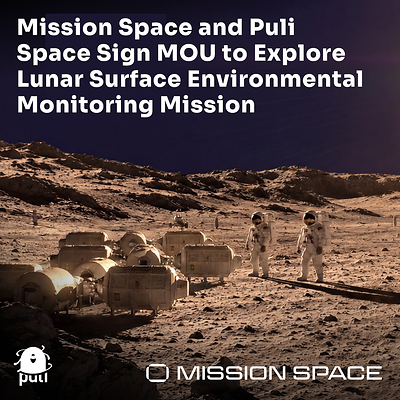
Mission Space and Puli Space Sign MOU to Explore Lunar Surface Environmental Monitoring Mission
PR Newswire
MIAMI and BUDAPEST, Hungary, July 22, 2026
MIAMI and BUDAPEST, Hungary, July 22, 2026 /PRNewswire/ -- Mission Space, a space-environment data company developing compact instruments for Earth orbit, cislunar space, and the lunar surface, and Puli Space Technologies, a Budapest-based lunar technology company developing lightweight rover platforms and lunar payload systems, today announced a Memorandum of Understanding to explore joint lunar surface missions using Puli Space's rover platform and Mission Space's lunar environmental monitoring instruments.
The MOU follows Mission Space's recent selection by NASA under an Announcement of Collaboration Opportunity to advance its lunar dust and surface-charging monitoring instrument in collaboration with NASA Goddard Space Flight Center. The company is extending its flight-proven space-environment measurement approach from Earth orbit toward lunar surface operations, where radiation, charged particles, dust behavior, and surface charging can affect rovers, landers, habitats, power systems, tools, astronaut activity, and other surface infrastructure.
NASA's recent "Ignition" initiative and Moon Base planning establish a phased approach for building sustained lunar surface capability, beginning with robotic missions, technology demonstrations, and early surface operations near the lunar South Pole. NASA describes the Moon Base effort as a step-by-step program to test systems, explore the lunar environment, and mature the infrastructure needed for long-term human presence on the Moon. Environmental measurements are part of the operational layer needed to design, operate, and protect that infrastructure.
Under the MOU, Mission Space and Puli Space intend to evaluate a lunar mission concept in which Puli Space's rover provides mobility, surface access, local terrain context, rover telemetry, and mission operations support, while Mission Space instruments collect localized measurements of the lunar environment along rover traverses and at mission-relevant locations.
"Mission Space is focused on turning lunar environmental measurements into an operational data layer for the Moon," said Mary Glaz, CEO of Mission Space. "A rover-based mission allows us to measure how the local environment changes across terrain, illumination conditions, rover activity, and selected surface locations. That data is relevant for future lunar infrastructure, anomaly attribution, mission planning, and long-duration surface operations."
"Puli Space was founded to make Hungary part of the next chapter of lunar exploration," said Tibor Pacher, CEO of Puli Space. "Our Puli Lunar Water Snooper — winner of NASA's 'Honey, I Shrunk the NASA Payload' award and flown to the lunar south pole under an ESA contract — has already returned data from the lunar surface. This collaboration with Mission Space is a natural next step: pairing rover mobility with environmental measurements. Future lunar infrastructure will need not only measurements, but maps."
The companies will also explore a joint commercial lunar surface data product combining Mission Space environmental measurements with Puli Space rover context, location, traverse, and surface operations data.
About Mission Space
Mission Space develops compact space-environment monitoring instruments and data products for radiation, charged particles, dust, surface charging, and related space-weather effects in Earth orbit, cislunar space, and on the lunar surface. The company combines in-situ measurements from its own instruments with forecasting and analytics software to provide environmental data, localized warnings, and validated data products for satellite operators, government agencies, defense users, lunar missions, and commercial space infrastructure.
About Puli Space Technologies
Puli Space develops a range of lunar exploration technologies. These include the NASA award-winning Puli Lunar Water Snooper (PLWS), a rugged, micro-sized, lightweight neutron spectrometer for exploring lunar water resources and, building on Puli's Google Lunar XPRIZE heritage, a low-cost, lightweight planetary rover platform with unique high-mobility capabilities. Puli also explores selected Earth-based applications of its space technologies. On Intuitive Machines' IM-2 mission to the lunar South Pole region in March 2025, PLWS became the first Hungarian instrument to land on the Moon and return data from the lunar surface.
About NASA's Moon Base and Ignition efforts
See NASA Moon Base, NASA Ignition
Media Contact
Mission Space: Mary Glaz / 419220@email4pr.com / +1 305 798 97 55
Puli Space: Tibor Pacher / 419220@email4pr.com / +36 70 77 21 727
 View original content to download multimedia:https://www.prnewswire.com/news-releases/mission-space-and-puli-space-sign-mou-to-explore-lunar-surface-environmental-monitoring-mission-302831082.html
SOURCE Mission Space and Puli Space