The Longevity Market Is Leaving $350 Billion on the Table in Unmet Demand From Women in Perimenopause and Menopause
PR Newswire
BOSTON, Sept. 22, 2026
- BCG Survey of 10,600 People Finds That Women Undergoing Perimenopause or Menopause Are the Most Engaged (and Among the Least Satisfied) Longevity Consumers
- These Women Already Outspend Every Other Age Group, but a Third of Them Would Spend Even More If the Right Product or Service Existed
- Women's Interest in Long-Term Health Typically Starts in Their Mid-30s, a Decade Before the Longevity Market Starts Paying Attention
BOSTON, Sept. 22, 2026 /PRNewswire/ -- Women in perimenopause or menopause are the most engaged, highest-spending longevity consumers, yet their needs remain underserved. New research from Boston Consulting Group (BCG) puts a number on that care gap: applied across the roughly 1 billion women worldwide who are in menopause and are already spending on longevity, the unmet demand adds up to an estimated $350 billion.
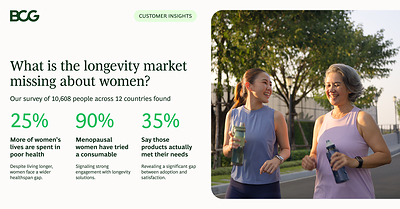
This insight comes from BCG's 2026 global study on longevity, titled The $350 Billion Longevity Mismatch in Women's Health. The report, conducted for the St. Moritz Longevity Forum, draws on a survey of 10,608 people across 12 countries.
Among the report's findings:
- Women in perimenopause or menopause adopt longevity interventions (such as consumables, services, and specialized treatments) at rates 15 to 22 percentage points higher than other women or men. They've also tried, on average, 3.3 more interventions across categories than other women and 2.9 more than men.
- Despite this, women in this life stage report no higher satisfaction than anyone else surveyed, with every group stuck around 50%.
- Women in perimenopause or menopause already spend more on longevity than any other group surveyed (a median $84 a month, versus $68 for other women and $73 for men). Roughly a third would spend more ($108 a month) for a product or service that showed results.
- Women's interest in long-term health often starts well before menopause. Hormonal shifts and fertility challenges, which occur on average at age 36 to 38, raise their interest in long-term health by 8 percentage points—nearly double the effect of menopause itself (5 percentage points). Men show no comparable shift until roughly a decade later.
"Companies wait for menopause before they start talking to women about long-term health, but the real window opens about a decade earlier," said Parul Bajaj, a BCG managing director and partner, and a coauthor of the report. "Treating those hormonal shifts in the mid-30s as short-term symptoms, rather than the turning point they actually are, is one of the biggest blind spots in how the market serves women today."
Women's Health Needs Persistently Go Undiagnosed and Undertreated
The care gap isn't limited to menopause. BCG's survey found that just 63% of women consult a doctor about hormone-related issues such as PCOS, endometriosis, or menopause, compared with 78% who do so for cardiovascular conditions. And among women who do seek such care, only 72% say they felt taken seriously, versus 85% for those who seek treatment for heart-related symptoms.
"Women have long been asked to fit into a health care system that wasn't designed around their needs or biology," said Trish Stroman, a BCG managing director and senior partner, and a coauthor of the report. "Addressing that mismatch starts with more research and better provider training. It also means giving women a larger voice in deciding which longevity solutions get developed and funded."
"Women in perimenopause or menopause already spend more on longevity interventions than any other group, yet they're no more satisfied with the solutions available to them. We call this the longevity mismatch," said Mark Abraham, global leader of BCG's Marketing, Sales & Pricing practice, and a coauthor of the report. "They're telling the market that they're ready to spend but they aren't finding what they need. The companies that bridge that gap can set a new standard for how the longevity market serves women—and claim their share of a $350 billion prize."
Download a copy of the report here:
https://www.bcg.com/publications/2026/womens-longevity-health-market-gap
Media Contact:
Kendall Kosten
kosten.kendall@bcg.com
About Boston Consulting Group
Boston Consulting Group bridges the gap between ambition and outcomes for the world's leading companies and organizations. We are built for this era of unprecedented change — bringing strategic clarity rooted in over 60 years of deep domain knowledge, combined with applied AI shaped by our practitioners. BCG works shoulder-to-shoulder with CEOs across industries and geographies to deliver transformative impact at scale: stronger returns, transferred capabilities, and change that sticks. For more information, visit bcg.com.

 View original content to download multimedia:https://www.prnewswire.com/news-releases/the-longevity-market-is-leaving-350-billion-on-the-table-in-unmet-demand-from-women-in-perimenopause-and-menopause-302885361.html
SOURCE Boston Consulting Group (BCG)